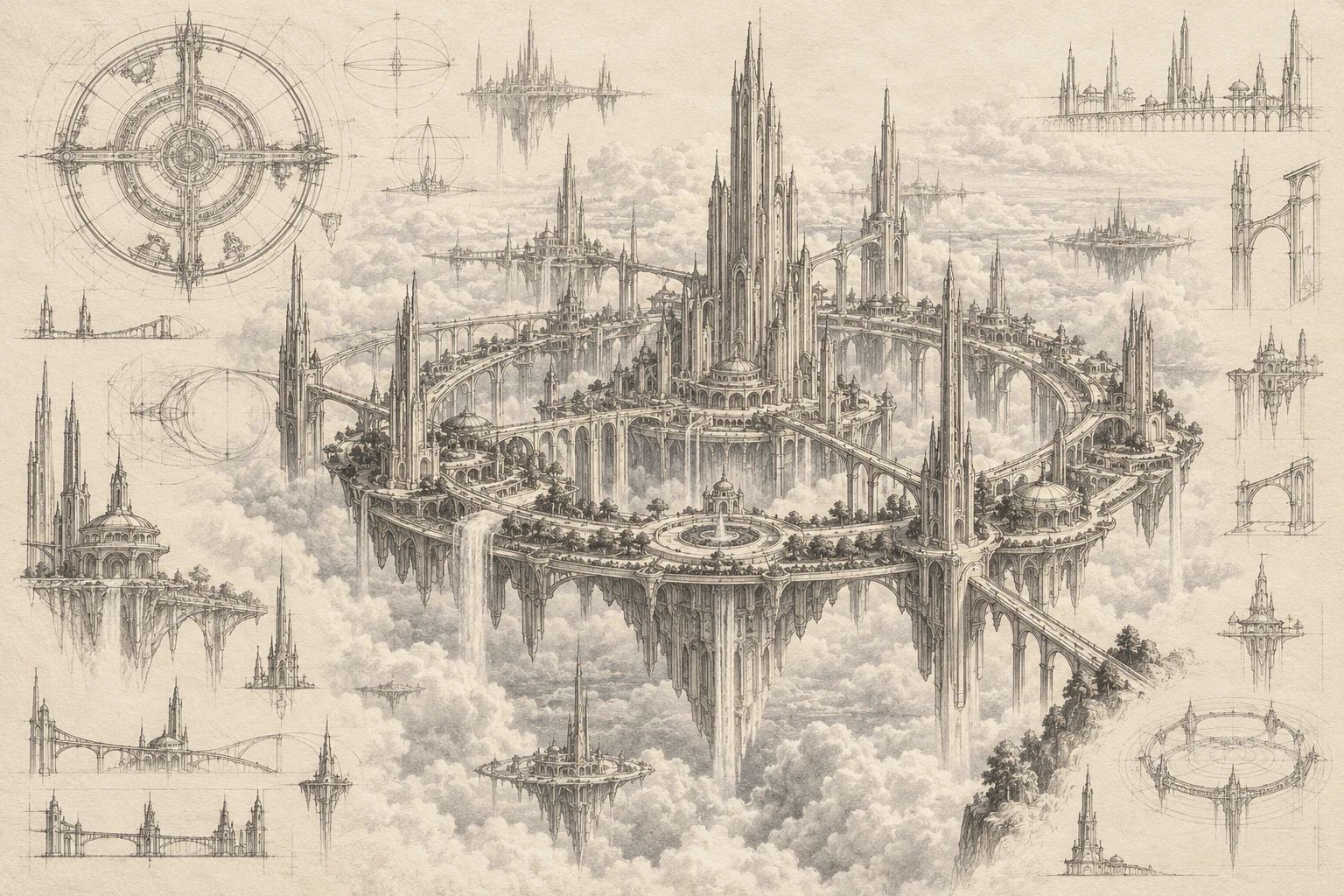
The first mistake in my drawing is the horizon. I gave the city one because a page seems to need a place where the sky begins. The city itself had no such agreement. There were towers below us and bridges above us, and a band of luminous cloud curved upward until it vanished behind the structures overhead. I kept looking for the ground. Sael noticed and asked me to sit before I made myself ill.
We were on a terrace that felt like warm stone. Beneath my fingertips its surface had a faint grain, but the grain moved when I stopped watching it directly. Far away, water fell from the underside of an island into clouds lit turquoise from within. There was no roar. I could hear a low, layered note that changed whenever a shadow passed across the terrace. I initially thought the city was singing. Later I wondered whether I was hearing its machinery.
A ring cut diagonally across the sky. It was not a thin decorative line. I could distinguish dusty bands, bright fragments, and dark gaps wide enough to swallow the familiar moon. The scale made my stomach tighten. Sael rested her hand beside mine, leaving a little space between our fingers. I concentrated on that space. It was something I could measure. For a while it was the only thing that made sense.
The buildings were slender, but not fragile. Their lower surfaces opened into broad curves and their upper levels branched into platforms with no visible supports. Light travelled along their edges in amber pulses. Some towers darkened as others brightened, as though the whole place was breathing through different lungs. I saw people crossing a bridge that appeared to be made of reflections. Their feet touched it with complete confidence. I did not ask to try.
Someone brought a shallow vessel of water. The person was shorter than Sael, with dark hair gathered at the back of their head and a small mark beside one eye. I remember that mark more clearly than their clothes. The water tasted faintly of cucumber and something mineral. I was absurdly grateful to discover that I could still be thirsty. Until then I had felt as if wonder might replace every ordinary need a body had.
We walked into a passage with one transparent wall. Beyond it a cloud moved slowly upward, revealing a lower district arranged around a broad circular pool. Small craft travelled between terraces without leaving trails. I could not find an engine sound. Each time I focused on a particular craft, the rest of the city seemed to lose its scale again. Sael suggested that I look at nearby things first. A door handle. A seam in her sleeve. The cup I was still carrying.
I asked who had built it. The answer arrived as a sequence of hands, not a name: pale hands working beside copper-colored ones, a surface being grown and then carefully cut, people arguing over a model, a child sleeping beneath a table while adults worked. That last image stayed with me. I had been imagining something beyond human categories. Instead I was being shown labor, compromise, and someone bringing their child to a place where there was work to finish.
At the terrace edge I finally saw what looked like a shoreline. It curved beneath the cloud belt, crowded with lights. I asked whether this was a planet. Sael hesitated. The hesitation was real, or at least it felt real to me. She offered several overlapping impressions: a place, a vessel, a gathering, something that had moved and something that had remained. I could not hold them together. She did not insist that I should.
I came home with a headache and the conviction that I had forgotten something simple. I drew until morning, building a horizon that had not existed and adding supports beneath bridges that had not needed them. The finished page is a translation into the things my hand already knows. Whenever I look at it, I remember the person with the mark beside one eye. I wonder whether they put my cup away after I left, and whether the city seemed ordinary to them.
Anna